Printing Employee Badges & ID Cards in Jordan: EAPPress Guide
At EAPPress in Russeifa, Zarqa, print planning starts with the purpose of the finished piece and the available budget. This guide covers Printing Employee Badges & ID Cards in Jordan and helps businesses in Jordan prepare a clear specification before requesting a quote.
Why does your company need ID badges?
It isn't just about appearances. An ID badge serves several practical purposes in any Jordanian workplace:
- Security and access control: telling employees apart from visitors and contractors, especially on construction projects and at healthcare facilities.
- Customer confidence: clients feel far more at ease dealing with a staff member whose name and job title are clearly displayed.
- Regulatory compliance: many authorities and shopping complexes in Amman require an ID card to be worn during working hours.
- Administrative control: linking the badge to your attendance system via barcode or RFID.
- Indirect marketing: every badge carrying your logo travels with you to every client visit and external meeting.
Types of badges and ID cards in Jordan
1. PVC plastic badge
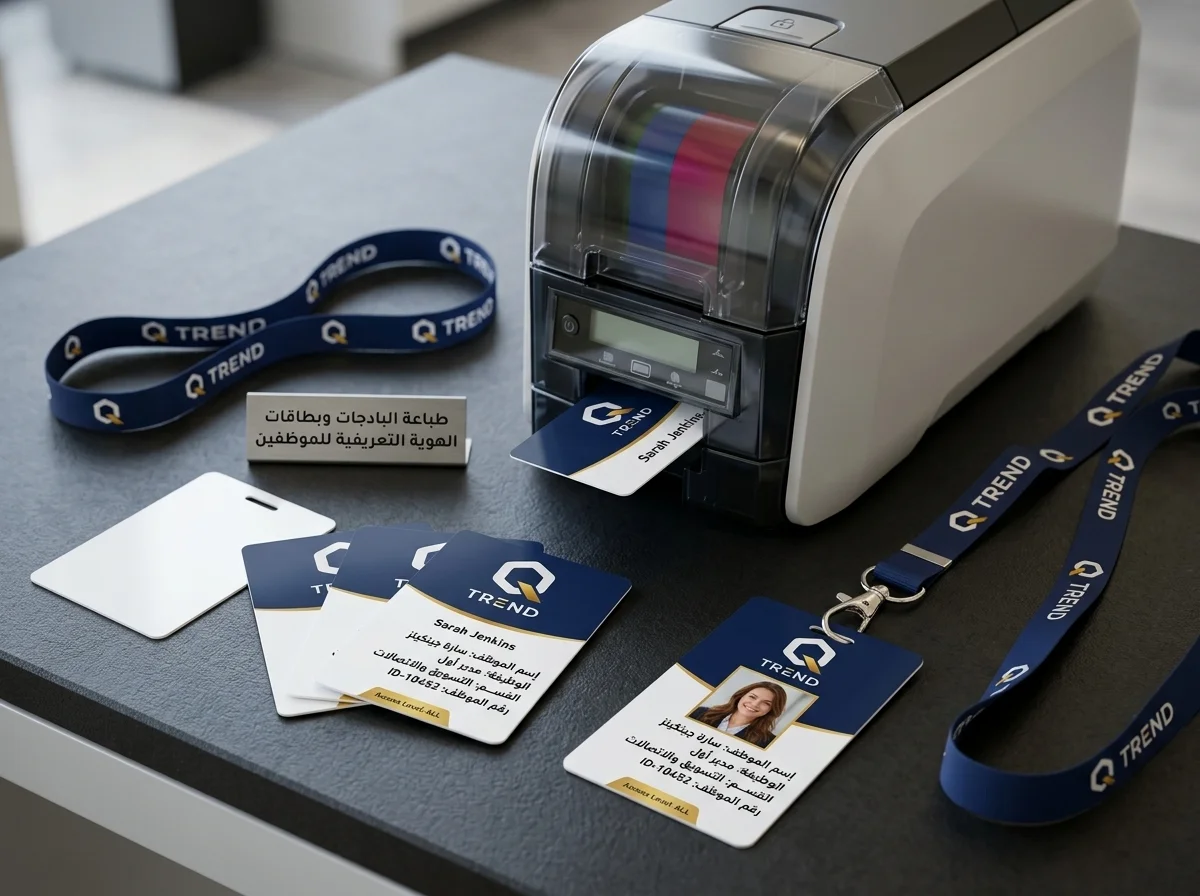
The most popular choice for permanent employee cards. Printed on 0.76 mm PVC card in credit-card size, with full-colour printing on both sides. It resists water, bending and abrasion, and stands up to years of daily use. You can add a slot at the top or side for a lanyard, or fit a metal clip on the back.
2. Conference and event badge
Printed on 300 gsm rigid board in A6 or 100×140 mm and inserted into a clear plastic holder with a lanyard. Ideal for exhibitions and conferences in Amman because it's economical, and attendee names can either be pre-printed or left blank to be written in at the registration desk. It's often produced in colour codes to distinguish categories: speaker, organiser, visitor, press.
3. Metal or acrylic name badge
An elegant badge fixed to the uniform with a magnetic clasp or pin, produced by laser engraving on metal or UV printing on acrylic. Common in hotels, upscale restaurants, banks and salons, it gives a refined look that suits face-to-face customer service.
4. Smart badge (RFID / NFC)
A PVC card with an embedded chip that works with access control, attendance or car park systems. The chip type and frequency must be specified before production to guarantee compatibility with your existing system. For more options, take a look at our business cards service, which shares the same printing and finishing standards as badges.
5. Temporary visitor badge
Used at company headquarters, factories and construction sites. It's usually produced in a distinctive colour with "VISITOR" in large type, and made either wipe-clean for writing with a whiteboard marker so it can be reused, or with sequential numbering for easy tracking.
Lanyards and holders: the detail everyone forgets
The lanyard is no minor accessory — it's the most visible part of the badge. Here are the options available in Jordan:
- Printed polyester lanyard: 10, 15 or 20 mm wide, printed with your company name or logo on repeat. The most common and most economical option.
- Satin lanyard: a soft feel and refined sheen, well suited to conferences and formal events.
- Woven lanyard: the text is woven into the fabric rather than printed on it, so it never fades — ideal for long-term use.
- Holders: rigid plastic, leather, or retractable (yo-yo) holders, the latter being extremely practical with card readers at doors.
- Accessories: metal clips, swivel hooks and breakaway safety clasps (important in factories and on construction sites).
Rules for designing a professional badge
A badge is a small canvas, and any clutter defeats its purpose. Follow these rules:
- The employee's name is the star: it should be the largest text element and legible from at least a metre and a half away.
- Job title in smaller type: placed directly beneath the name, at no more than 60% of the name's size.
- Logo at the top: balanced in size so it doesn't compete with the name, and always in your official brand identity colours.
- Photograph: use a consistent background and similar lighting for all employees, at a minimum resolution of 300 dpi.
- The reverse side: reserve it for the barcode, employee number, emergency contacts and a return-if-found notice.
- Bleed and margins: allow 3 mm bleed and keep text 4 mm away from the edges to avoid trimming, and supply the file in CMYK.
- Bilingual layout: in Jordan it's best to show the name in both Arabic and English, keeping the two scripts visually balanced.
Variable personalisation: printing hundreds of names without errors
When printing badges for dozens or hundreds of employees, we use Variable Data Printing, where an Excel file containing names, job titles, numbers and photos is linked to the design template so each card is automatically printed with its own data. This saves time and eliminates manual copying errors. All you need to provide is a tidy, proofread spreadsheet and a photo folder with files named by employee number.
The badge as part of a complete identity system
The best results come when the badge is consistent with the rest of your printed materials: the same colour tones, the same typeface, and the same approach to logo usage found on your folders and official stationery, business cards and uniforms. If you haven't adopted a brand guide yet, starting with a complete brand identity ensures every item you print afterwards — from the badge to the shopfront sign — speaks the same language.
Factors that affect the price
- Quantity: the unit price drops noticeably once you pass 100 and 500 cards.
- Material: PVC costs more than board, and metal costs more than both.
- Added technologies: smart chips, magnetic stripes, sequential numbering and security holograms.
- Lanyard and holder: the type of lanyard and how it's printed make up a significant share of the final cost.
- Single or double-sided: printing both sides adds slightly to the cost but delivers far more practical value.
- Turnaround speed: rush orders within 24 hours may carry an additional charge.
Practical tips before sending your order
- Check the spelling of Arabic and English names twice — one wrong name means reprinting an entire card.
- Ask for an approved proof before full production, especially on large orders.
- Print an extra 5–10% of blank cards as spares for new hires or lost cards.
- Standardise the background of all employee photos before sending them over.
- Set a clear colour scheme for departments if you want visual distinction between teams.
At EAPPress we produce badges and ID cards for every sector in Amman and across Jordan: from PVC cards for permanent staff, to conference and event badges, to lanyards printed with your logo. Send us your list of names and your company logo, and we'll come back with a proposed design and a clear quotation. Contact us now on WhatsApp at +962 7 9821 5060 and start giving your team a professional identity.
Prepare your request for EAPPress
Send a PDF artwork file with the final dimensions, quantity, material and finishing requirements. Mention any folding or cutting before approving the file. Review names, contact details and colours, then confirm the collection date once specifications are agreed.
Request an individual quote in Jordanian dinars based on your job. Contact EAPPress in Russeifa on WhatsApp +962 7 9821 5060, browse our printing services, or send your requirements through the contact page.
Frequently Asked Questions
What's the difference between plastic badges and paper badges?
How long does it take to produce staff badges in Amman?
Can the badges be linked to an attendance system?
What is the standard size for an employee badge?
Need printing or advertising services in Jordan?
Contact EAPPress today for a free quote on your project in Amman and across Jordan.
Related Articles
Printing for Art Galleries in Jordan: EAPPress Guide
Printing Essentials for Recruitment Agencies and Manpower Offices in Jordan: EAPPress Guide
Printing Essentials for Butcher Shops and Fish Markets in Jordan: EAPPress Guide